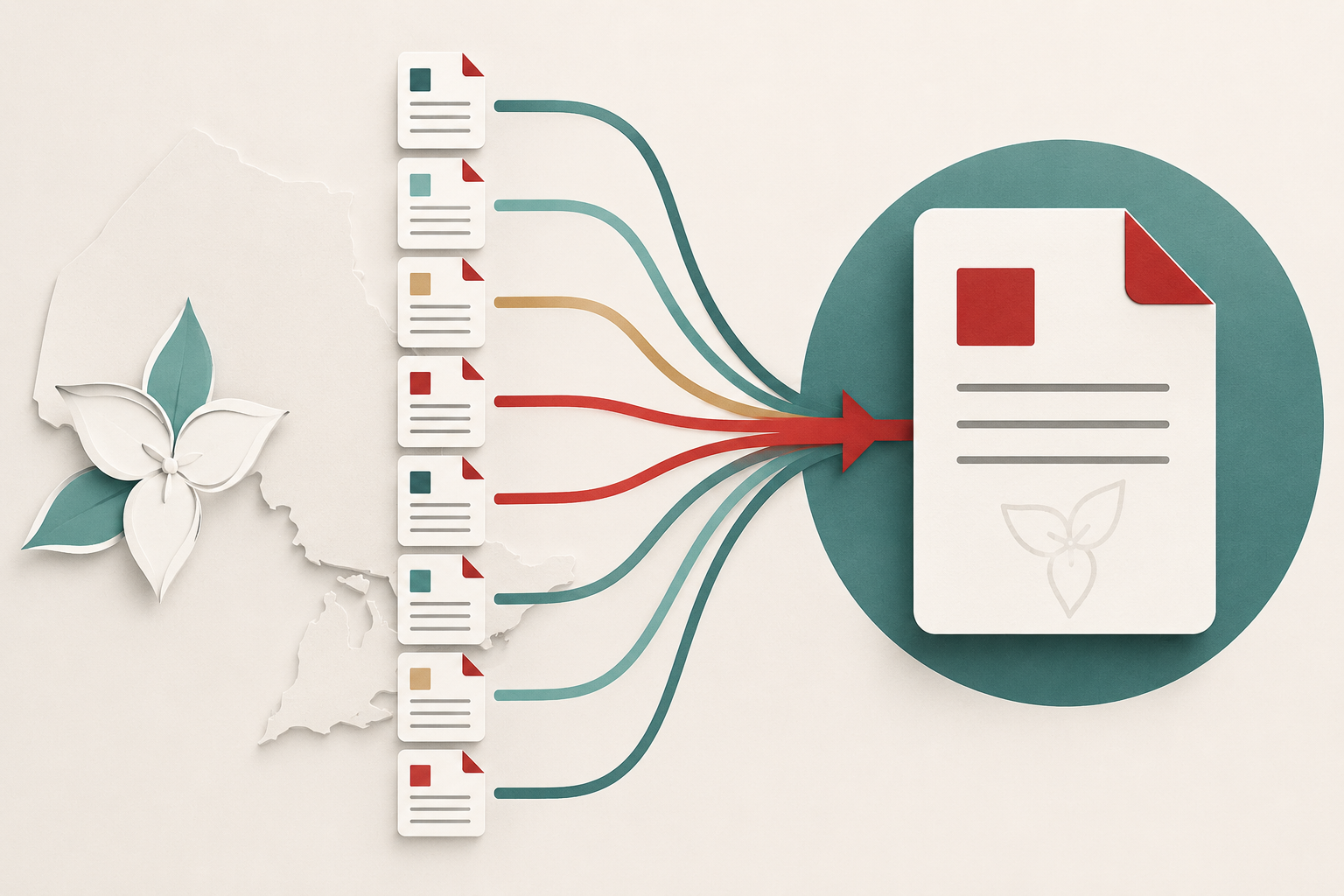
Ontario didn't tweak its immigration program today — it scrapped the whole thing. The eight streams that existed under Ontario Regulation 422/17 are gone, replaced by one: the Ontario Workforce Priority Stream. The amending regulation (O. Reg. 204/26) came into force this morning. Here's exactly what changed, drawn from the old and new versions of O. Reg. 422/17.
If you had a pending EOI: your profile is being automatically withdrawn. No further invitations will be issued under the old streams. Read on for what this means and what comes next.
The eight streams that closed today
Every category previously listed in O. Reg. 422/17 has been revoked. There is no grandfather clause for unsubmitted applications.
- Employer Job Offer: Foreign Worker
- Employer Job Offer: International Student
- Employer Job Offer: In-Demand Skills
- Masters Graduate
- PhD Graduate
- Express Entry: Human Capital Priorities
- Express Entry: French-Speaking Skilled Worker
- Express Entry: Skilled Trades
Each had its own section in the regulation, its own scoring criteria, its own NOC restrictions, and its own draw cycles. A foreign worker with a job offer applied under a different stream than an international student — even if they were doing the same job for the same employer.
Applications that were already submitted and acknowledged before today will continue to be assessed under the rules that were in place at the time of submission. That protection is preserved in the regulation.
What replaced them: the Ontario Workforce Priority Stream
One stream. Three pathways. Every NOC occupation from TEER 0 to TEER 5 is now eligible — there is no pre-approved occupations list baked into the stream structure, though Ontario can still run targeted draws.
TEER 0–3 pathway — skilled workers
- Job offer: full-time, permanent position in Ontario
- Experience (one of the following): 6 consecutive months with the job-offer employer in the last 12 months; OR 3 months for recent Ontario graduates; OR 2 cumulative years in the same NOC occupation over the last 5 years. Licensed professionals (engineers, pharmacists, etc.) are exempt.
- Language: CLB 6 minimum (CLB 5 for certain occupations) — new mandatory floor
- Education: post-secondary degree or diploma — new requirement
TEER 4–5 pathway — essential workers
- Job offer: full-time, permanent position in Ontario
- Experience: 9 cumulative months in the last 2 years in the job-offer position with the job-offer employer — must be with the same sponsoring employer
- Language: CLB 4 minimum — new mandatory floor (no test was required before)
- Education: Canadian high school diploma or equivalent (ECA if international) — new requirement
Self-employed physicians — no job offer required
- Must be a member in good standing with the College of Physicians and Surgeons of Ontario
- Hold a valid certificate of registration (independent, academic, or provisional class)
- Be eligible to bill through OHIP
Book a consultation with our licensed RCIC. We'll review your job offer, experience, language, and education against the new rules and map out your next steps before the portal reopens.
Book a Consultation →What actually changed — before vs. now
The most consequential changes are the new language and education floors. Many workers who qualified under the old system without a language test will now need one.
| Before (old streams) | Now (Workforce Priority) | |
|---|---|---|
| Program structure | 8 separate streams, each with distinct NOC lists, scoring, and draw cycles | 1 stream, 2 occupation-level pathways — covers all TEER 0–5 |
| Language — TEER 0–3 | No regulatory minimum in Foreign Worker stream (language was a scoring factor, not a hard cutoff) | CLB 6 mandatory (CLB 5 for certain occupations) — new hard floor |
| Language — TEER 4–5 | No minimum at all under In-Demand Skills stream | CLB 4 mandatory — new requirement for this group |
| Education — TEER 0–3 | No education requirement in Foreign Worker stream | Post-secondary degree or diploma required — new |
| Education — TEER 4–5 | No education requirement in In-Demand Skills stream | Canadian high school diploma or equivalent (ECA if international) — new |
| Work experience — TEER 0–3 | 24 months cumulative in the past 60 months (5 years) in the NOC occupation; did not need to be with the job-offer employer | Three routes: 6 months with employer, 3 months for Ontario grads, or 2 years in same NOC (last 5 years). Licensed workers exempt. |
| Work experience — TEER 4–5 | Varied by occupation; employer-specific experience required but timeframes differed by stream | 9 months cumulative with job-offer employer in last 2 years — specific to the sponsoring employer only |
| NOC coverage | Each stream restricted to a specific published list of NOC codes | All TEER 0–5 occupations eligible; no pre-approved list required |
| Employer revenue — GTA | $1,000,000 gross annual revenue | $1,000,000 (unchanged); reduced threshold added for rural communities |
| Employer revenue — outside GTA | $500,000 gross annual revenue | $500,000 (urban areas); lower threshold for census divisions under 150,000 population |
| Penalty response window | 60 days to respond to a Notice of Intent for an AMP or Ban | 30 days; notices now served by email and deemed delivered without proof of receipt |
| Graduate streams | Masters and PhD streams open to Ontario university graduates | Closed. No equivalent in Phase 1. Expected in Phase 2 (no date set). |
| Express Entry–linked streams | Human Capital Priorities, French-Speaking Skilled Worker, Skilled Trades | All closed. No OINP-linked Express Entry pathway currently exists. |
For essential workers specifically: the In-Demand Skills stream had no language test and no education requirement. Both are now mandatory under the TEER 4–5 pathway. If you haven't taken a CLB test, that's the first step to arrange before the new portal opens.
What's gone and not coming back (yet)
The Masters and PhD Graduate streams are closed. The Express Entry Human Capital Priorities stream is closed. The French-Speaking Skilled Worker stream through Express Entry is closed. These pathways for international graduates and Express Entry-linked candidates don't have a direct equivalent in Phase 1.
Ontario's announcement says Phase 2 will introduce a Priority Healthcare Stream, an Entrepreneur Stream, and an Exceptional Talent Stream — but no launch date has been set for any of them.
The bottom line
If you applied under the old streams: your application gets assessed under the rules that existed when you submitted. The regulation preserves that.
If you had a pending EOI: your profile is being automatically withdrawn as Ontario rebuilds the portal. No action is needed on your end for the withdrawal itself — you will receive a notice from Ontario directly.
Once the EOI is withdrawn, the job offer that was registered under the old stream is gone with it. When the portal reopens, your employer will need to submit a new job offer under the Ontario Workforce Priority Stream before you can register a new EOI. Employers who are already in the employer portal don't need to create a new account — but the job offer itself has to be resubmitted. Don't ask your employer to do this yet. Wait until the portal is open and your eligibility under the new rules is confirmed, then coordinate on timing.
Ontario expects the new EOI portal to reopen later this summer. No specific date has been confirmed.
The regulation text is at ontario.ca/laws/regulation/170422 — worth reading directly if your situation is complex.
This article is for general information purposes and reflects O. Reg. 422/17 as amended by O. Reg. 204/26. It does not constitute legal or immigration advice. For guidance specific to your situation, consult a licensed immigration consultant.